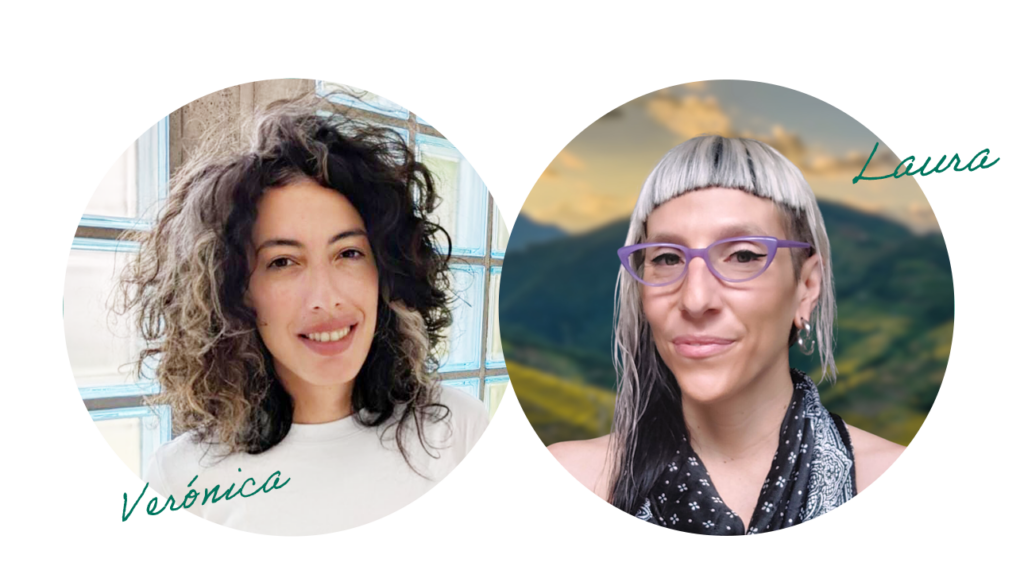
We are thrilled to share insights from the editors of our first Executive Report: Regenerative Agriculture and Resilient Food Systems. Our wonderful Editors Verónica Zuccarelli Freire and Maria Laura Pey share with us the inspirations behind their research and the insights they hope readers will take from the report.
Who or what has inspired your research?
Verónica: My research is focused on agricultural landscapes, so I think what inspires me is the beauty of human creativity and resilience. I know that currently we are overwhelmed by the negative view of mankind’s bad behaviour that is bringing our world to a tipping point. This is based on facts. But we are, and have always been, able to fertilize places where nothing could grow, where there’s water scarcity and all this throughout past climate changes. Of course, now the difference is that the climatic crisis is mainly of our own making.
I would also say that the ones who inspire me and renew my will to continue our research are the Indigenous communities in the NW Argentinian Andes, who we have worked and collaborated with for so many years. Every single journey humbles me with the respect and love they have for their land. Every visit reminds me of how deep and strong these roots are, and how alive they are, despite history.
Laura P.: I’ve always been drawn to archaeology because, beyond being a way to travel across time and space, it lets us connect with other ways of conceiving and making the world. I think that variability itself is a source of richness full of valuable insights, or alternatives, for how to relate to one another in society and to our world. What inspires my current research is how landscapes hold memory, and how Andean communities, across time and into the present, keep taking up that memory through practice (and, of course, through narrative). The high-Andean agrarian landscapes I study are a striking example of this. The terraces (andenes) built there are not simply infrastructure. They’re a form of accumulated, embodied knowledge about how to manage water efficiently and keep soil in place, for sure! But beyond that, they also tell the story of generations upon generations of families who inhabited the same places through shifting social, political, and environmental changes, devising creative strategies to work through them. I’m convinced there’s a great deal to learn from them, on every one of those fronts.
What is a place that has most influenced how you think about regenerative agriculture and resilient food systems?
Verónica: The Andes. The Andes defies all the prejudices of what a ‘productive’ landscape means. You cannot use global Earth-systems models to understand the food systems and regenerative agriculture there because a desertic land at 4,000 meters above sea level is not supposed to be a fertile place. However, they are, through millennia of biocultural engineering undertaken by the Indigenous Peoples from North to South of this mountain range. One of the most globally important crops that saved many countries from starvation comes from the Andes: the potato. I think that speaks for itself.
Laura P.: I’ve spent over a decade studying the agricultural terraces of a sector of the Puna de Jujuy, in Argentina, a high-altitude desert above 3,600 meters. Every survey season reminds me that these landscapes are not passive backdrops. They are the result of centuries of deliberate, collective decision-making by the people who built and maintained them. Working alongside local Quechua communities has shaped how I understand “productivity” itself: it’s never just about geophysical conditions, but about how a place is perceived, inhabited, and cared for across generations. Fertility, in the end, isn’t only a matter of whether the natural soil qualifies as suitable by modern agronomic standards. As long as someone has the capacity to imagine that landscape in green and is willing to do the work —sustaining a balance among the different elements or, from an Andean ontology, the different entities that make up the world— it can be cultivated. That understanding helps us move past the limits our own Western way of seeing the world tends to impose on us. There’s nothing like encountering other ways of thinking and inhabiting the world to put pressure on our categories, and that, over the medium or long term, can inspire us to think through solutions to problems we all share, like climate change.
What is one insight from the report that you think everyone should know?
Verónica: I would say the report contributes to a key question: What if some of humanity’s most effective strategies for living with environmental uncertainty already exist? And what if we listen to the historically marginalized groups whose knowledge of regenerative agriculture and sustainability was long proven to be effective? I think the report and the amazing contributors who collaborated on it share several examples of this, and most importantly, perhaps the key change may not be technological, but mental. How we think about our current crisis.
Laura P.: I’d point to the section on resistant crops from traditional and Indigenous agriculture. These plants get promoted worldwide almost like a technical fix: drought-tolerant, nutrient-dense, adaptable to poor soils, ready to be scaled up wherever food insecurity or degraded land demands a solution. But it’s absurd to lift a crop out of the context that actually produced its resilience. Regarding quinoa, which is the crop I know best among those mentioned, what strikes me most isn’t its agronomic profile, it’s everything behind it: centuries of farmers reading their landscape, exchanging seed, building soil fertility through relationship rather than input. That knowledge is what made quinoa resilient in the first place, and it’s exactly what gets lost when a crop is extracted as a “resistant” commodity rather than understood as a living practice. If we’re serious about food security, the more valuable lesson isn’t the nutritional chart, it’s the centuries of accumulated knowledge that made this cultivation possible to begin with, and the people who still hold it.
And there’s an ethical and political commitment involved here too, toward the communities that still hold and transmit this knowledge. They aren’t just informants supplying patterns for technical improvements or “wonder crops”. They are actors within a field of political tensions, and as researchers it matters that we understand and support their struggles to defend their territories, and that we create real spaces to hear what they have to say, including their demands.