If you’re in Berlin this November, you can visit our team at Berlin Science Week! You can read more information about our exhibition stand and panel discussion below, and on the Berlin Science Week website at the following links: panel discussion, exhibition stand.
Exhibition Stand
6-8 November, Berlin Science Week Haus der Kulturen der Welt (HKW)
The exhibition stand will present the Perspectives from the Global South on the Anthropocene initiative, highlighting how Indigenous knowledge systems and traditional practices contribute to biodiversity conservation, climate resilience, and regenerative futures.
The stand will combine large-format educational panels, interactive activities, and short audiovisual narratives to engage visitors with diverse ways of understanding and caring for the living world. The exhibition will explore two interconnected themes: resilient food systems and biodiversity practices.
You can find more information about this event on the Berlin Science Week website via this link.
Panel discussion
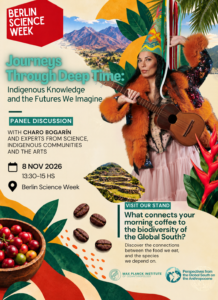
November 8th, 13.00 , Berlin Science Week, Festival Centre Event in the Haunani Kay Trask Hall. Haus der Kulturen der Welt (HKW)
The panel Journeys Through Deep Time: Indigenous Knowledge and the Futures We Imagine brings together Indigenous knowledge holders, artists, and researchers to explore how diverse knowledge systems and long-term human-environment relationships can inform the future of regenerative agriculture, biodiversity conservation, and resilient food systems. Through perspectives from the Brazilian Amazon, Argentina, and eastern Africa, the discussion will connect Indigenous knowledge, cultural heritage, and scientific research to contemporary environmental challenges. It will include the artistic performance of Indigenous music by Charo Bogarín.
Panellists:
Charo Bogarín
Argentine singer, songwriter, and cultural manager
Charo Bogarín is an Argentine singer, songwriter, and cultural manager of Guaraní descent. As a member of the musical duo Tonolec and through her solo work, she explores the connections between Indigenous musical traditions and contemporary artistic expression. In 2022, she was appointed Vice-President of the Instituto Nacional de la Música (INAMU), an Argentine government agency that promotes musical activities. In this role, she has expressed her commitment to promoting women in the music industry and safeguarding Indigenous musical traditions.
João Paulo Lima Barreto
Indigenous scholar and anthropologist, Yepamahsã (Tukano), Brazil
João Paulo Lima Barreto is an Indigenous scholar from the Yepamahsã (Tukano) people of the Brazilian Amazon. He holds a PhD in Social Anthropology from the Federal University of Amazonas and is the founder of the Bahserikowi Indigenous Medicine Center and Biatüwi, the first Indigenous Food House in Manaus. His work brings Indigenous knowledge systems into dialogue with anthropology, food practices, and Indigenous health.
Dr. Rahab N. Kinyanjui
Paleobotanist , Max Planck Institute of Geoanthropology, Germany
Dr. Rahab N. Kinyanjui is a paleoecologist and paleobotanist specializing in the reconstruction of past vegetation and environments in eastern Africa. As Group Leader of the Paleobotany Group at the Max Planck Institute of Geoanthropology in Jena and a senior research scientist at the National Museums of Kenya, she uses plant microfossils and other botanical remains to investigate long-term human-environment interactions and the evolution of landscapes.
Patrick Roberts
Director, Department of Coevolution of Land Use and Urbanisation, Max Planck Institute of Geoanthropology, Germany
Patrick Roberts is an archaeological scientist and Director of the Department of Coevolution of Land Use and Urbanisation at the Max Planck Institute of Geoanthropology in Jena, Germany. His interdisciplinary research combines archaeology, palaeoecology, and environmental sciences to investigate long-term interactions between human societies and the Earth system. His work explores how past land-use practices and human-environment relationships can inform our understanding of contemporary environmental challenges.
You can find more information about this event on the Berlin Science Week website via this link.